
How to Check Criminal History in Riverside
Begin with the kind of event, not just a name. Riverside Police Department records describe the initial report. The Riverside County Sheriff Inmate Information System answers current custody questions. Riverside Superior Court Public Access shows a filed case, its register of actions, calendars, and releasable documents. For a complete personal California summary, only the subject may use DOJ fingerprint review.
- Ask RPD Records for an eligible Riverside police report or file an eligible non-emergency report online.
- Search the Sheriff inmate system with a required last name and optional first name and birth date.
- Use Superior Court Public Access for a case number or paid criminal name search.
- Request records from the correct city, police, sheriff, or court custodian when online results are incomplete.
- Use California Live Scan and the record-review form for your own statewide DOJ summary.
These routes answer different questions. A city report may exist before a prosecutor files charges, while a court disposition may appear after a jail booking has ended. Checking more than one official custodian helps explain those timing gaps.
Riverside's Two Police Records Counters
RPD staffs two public counters with Police Records Specialists: 4102 Orange Street, Riverside, CA 92501, and 10540 Magnolia Avenue, Suite B, Riverside, CA 92505. Staff can take certain non-emergency reports, process stored-vehicle releases and correction citation sign-offs, address citizen concerns, and provide report copies to people authorized to receive them. Authorization matters because a police report is not automatically open in full.
The official RPD Records Bureau profile shows the city-specific service route.
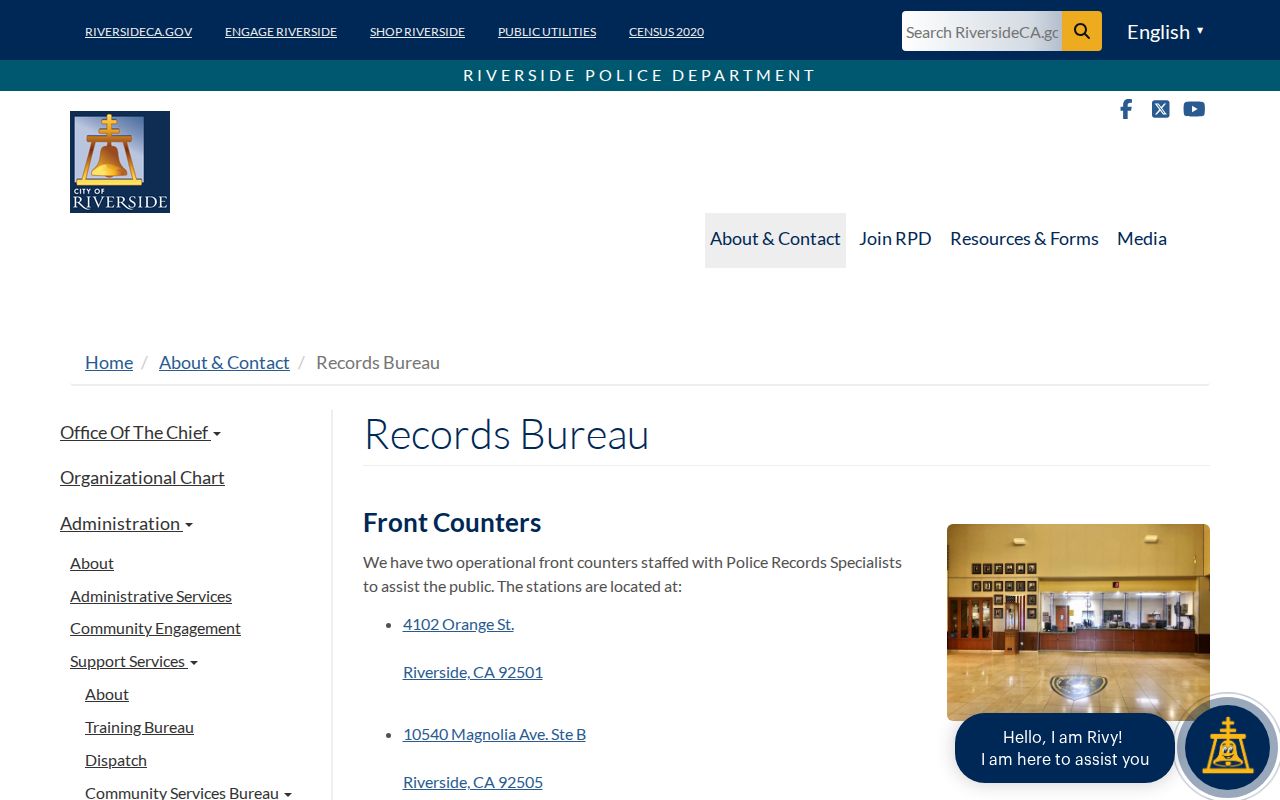
The bureau page is the best starting point for report categories and counter service, while custody and court questions belong to county offices.
The Riverside Police Department
RPD keeps the police-side file created by officers and records staff. Its online reporting option is free and can permit immediate submission when the event meets the listed rules. Eligible reports depend on incident type, location, evidence, suspect information, and risk. More serious or active events do not fit the online route.
RPD lists concrete counter categories, including certain thefts, vandalism or tagging, lost property, non-injury hit and run, vehicle tampering, harassing calls, suspicious circumstances, missing or runaway persons, and some threats with no immediate danger. Limits apply. For example, false impersonation reports are taken only at the Orange Street counter, and several property offenses have value or evidence conditions.
Riverside City Portal or Police Bureau?
The City of Riverside uses GovQA for city public records. That portal can reach city documents, but police report copies are more directly routed through RPD Records. A requester should describe the incident, date, location, report type, and connection to the event without asking City Hall to search an undefined body of police material.
The city records portal source illustrates the broader municipal route.
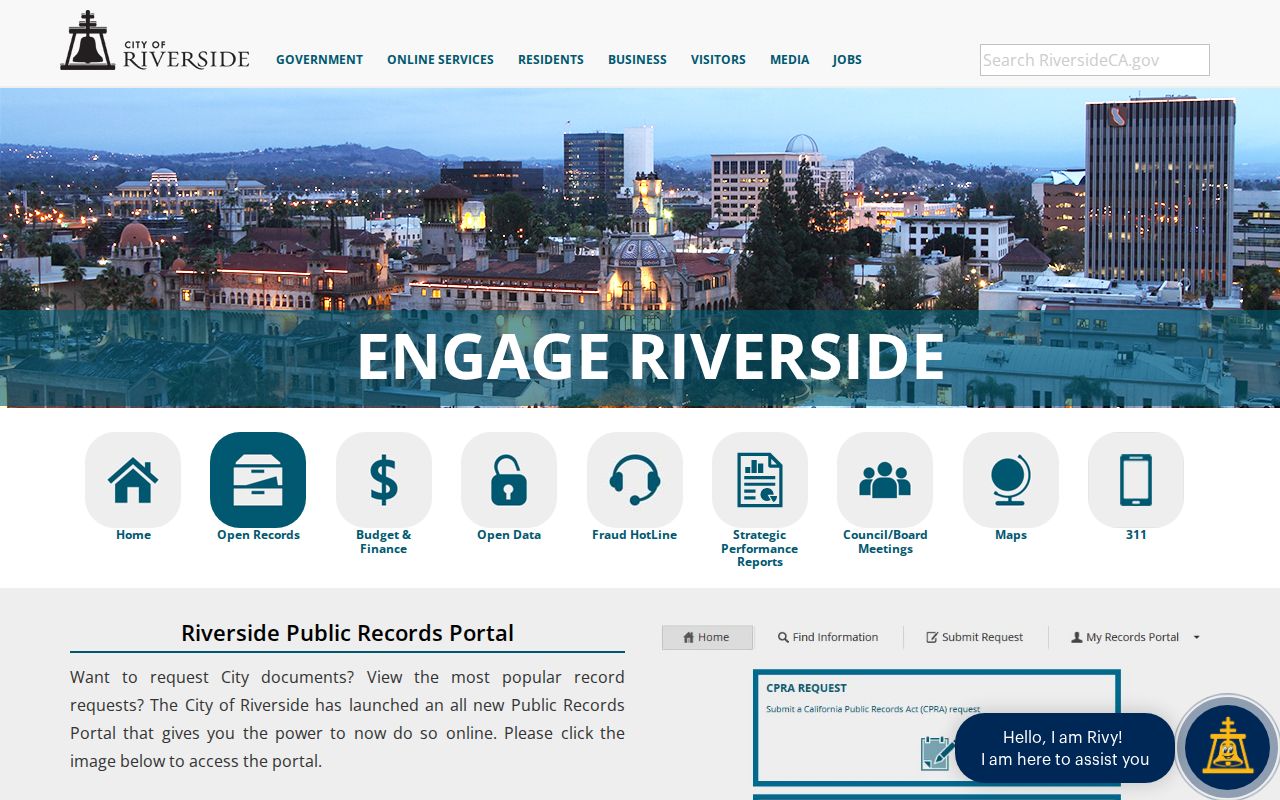
This distinction prevents a common delay: the city portal covers municipal records, while RPD controls police records and the Sheriff controls county jail files.
Arrests and Bookings in Riverside
RPD creates the arrest or incident report, but Riverside does not operate the county jail record system. When an arrested person enters county custody, Sheriff Corrections creates a booking number, intake data, charge list, custody status, fingerprints, photograph, bail information, and court connection. The official inmate search requires a last name and accepts a first name and date of birth to narrow results.
A person arrested in Riverside may be housed at Robert Presley Detention Center or another Riverside County facility based on classification, capacity, and court movement. The public result is a custody snapshot, not the complete police narrative and not proof of guilt. The broader Riverside County arrest history explains the county booking route in depth.
Downtown Riverside Justice Offices
Riverside's role as county seat makes its records landscape unusual. The Hall of Justice, Historic Courthouse, Sheriff-Coroner headquarters, Robert Presley Detention Center, District Attorney, Public Defender, and Probation offices are in or near downtown. Physical proximity does not merge their records. Each office maintains the part created by its legal role.
The Riverside County Public Defender homepage identifies the defense agency.

The Public Defender may assist eligible represented clients, but it is not the public custodian for police reports or general court searches.
The agency's office contact listing adds regional office details.

Those locations help a client reach counsel; public case records still come from Superior Court.
Riverside Municipal Court Records
Riverside has no separate city municipal criminal court database. California unified municipal courts into the Superior Court system. Riverside Hall of Justice at 4100 Main Street is a key local criminal courthouse, and Riverside Superior Court Public Access supplies the online case route. Case-number searches are free. Criminal and traffic name searches require an account and paid credits.
| Court Name | Superior Court of California, County of Riverside |
|---|---|
| Case Types Heard | Felony and misdemeanor criminal cases plus traffic matters within the court's assignment |
| Case Lookup Channel | Public Access account, case-number search, clerk service, or records and copies request |
| What the Docket Shows | Case number, register of actions, calendars, disposition entries, and permitted documents |
| Copies & Fees | Copy, certification, and document charges depend on the requested service |
Electronic access is convenient but is not the official record unless the court electronically certifies it. Restricted documents, sealed matters, and protected personal data do not become public merely because a case appears in the index.
Riverside Cases Need the County Portal
The court portal separates free case-number searching from name searching. It also limits use to 30 searches or case lookups in five minutes. Automated activity, multiple accounts, or attempts to evade the limit can lead to suspension. A focused search is faster and less likely to confuse two people with similar names.
When a case is missing, confirm spelling, date range, and whether charges were actually filed. An arrest may never become a court case. Paper or certified copies can be requested through the court's records process when the online register is not enough.
Where Riverside Records End Up
A Riverside event can produce several files. Police document the incident and arrest. Sheriff Corrections adds a booking if county custody follows. Prosecutors decide whether to file, and Superior Court then creates the case file. Fingerprints and later dispositions may reach the California Department of Justice repository.
Record flow: Riverside Police Department › Riverside County Courts › California Department of Justice
The flow explains why dates and outcomes may differ across systems. Recent activity is usually best checked with the creating local agency. A filed outcome belongs in the court record. A person checking their own statewide summary uses DOJ Live Scan and may challenge incomplete or inaccurate entries through DOJ's review process.
Riverside Population and Record Demand
Official 2020 Census figures identify Riverside as the county's largest incorporated city, with 314,998 residents. Its size and county-seat role place city police activity beside major county justice operations. Population does not predict an individual's record, but it does explain why precise identifiers and the correct office matter.
The Census data profile provides regional context.
City-specific searches should still use Riverside agency records rather than treating county population data as a criminal-record source.
Public Access Rules for Riverside Records
California law balances public access with privacy, safety, and due process. The California Public Records Act applies to city and police records, but exemptions can protect active investigations, confidential information, victims, witnesses, juveniles, and other restricted material. Court electronic access follows separate court rules. State summary criminal history has stricter dissemination limits and is not a public name-search product.
Key Statutes:
California Public Records Act gives access to disclosable government records while preserving statutory exemptions.
California Penal Code section 11105 limits dissemination of state summary criminal history.
California Rule of Court 2.503 governs public electronic access to trial court records.
California Rule of Court 2.504 explains when an electronic court record is official.
Ask for a defined record and expect redactions when the law requires them. A denial or partial release should identify the legal basis used by the custodian.
Correcting Riverside Record Differences
When systems disagree, contact the office that created the entry. RPD addresses its report, Sheriff staff handle booking data, and the Superior Court controls the docket disposition. California DOJ provides a challenge process when a fingerprint summary does not match the local source.
Keep report, booking, and case numbers with any court order. A Penal Code 1203.4 dismissal does not erase the historical case, and one office may update before another. Obtain the corrected local record first, then use it with downstream custodians. This order creates a clear paper trail.
Riverside Identifiers Prevent False Matches
A name alone can point to the wrong person, especially in a large city. Use a case number, booking number, report number, date of birth, event date, and location when the official form permits them. The Sheriff locator requires a last name and accepts two added identifiers. Court Public Access offers the strongest route when a case number is already known.
Read status labels with care. A listed charge may be an allegation at booking or filing, not a final judgment. The register of actions shows procedural entries, while the disposition states how the filed count ended. Certified copies come from the court, not from a screenshot of a search result. These distinctions make Riverside criminal record research both more accurate and fair.